About

The story behind the map.

The Character Formation Profile did not start as a website. It started as a book: a proposal for a Christian mind and body coaching model that takes both neuroscience and grace seriously.

The lineage

Standing on tested work

The four character structures, Attachment, Separation, Integration, and Adulthood, come from the character work of Dr. John Townsend and Scott Makin: character as "that set of abilities required to meet the demands of reality." The hiding patterns are adapted from Townsend's Hiding From Love (1996), which mapped how people learn to protect wounded parts of themselves, and what it costs them later.

Character Formation Coaching (Eggman, 2019) revised and extended that foundation into a full coaching model: ten measurable sub-structures inside the four structures, three growth levels for each, and the hiding patterns organized by structure, all integrated with attachment research, interpersonal neurobiology, memory reconsolidation research, and somatic work. The conviction underneath it all is old and simple: people grow in environments of grace, truth, and time, and no part of a person is beyond the reach of grace.

The book

Character Formation Coaching

Proposing a Christian Mind/Body Transformational Coaching Model. Aaron A. Eggman, with contributing author Sally Eggman. All original figures designed by Sally Eggman; this site rebuilds them as living, interactive charts with her work as the canon.

The author

Aaron Eggman

Aaron Eggman is the founder of Character Formation Coaching, an executive coaching and counseling practice. He trained in executive coaching at the Townsend Institute (Concordia University Irvine) under the character model this work extends, and serves students and families as a dean, counselor, and educator. He built this profile because the tools he needed for real character work with real people did not exist in public form.

Want to work through your map with a coach? Book a session with a Character Formation Coach.

The coaching modality

How the coaching works, in plain language

The book behind this site proposes a specific way of doing growth work. Here is that model without the academic vocabulary.

Why talking about problems is not enough

The patterns that run your life were not learned by thinking, so they rarely change by thinking. They were learned by feeling, usually in hard moments you faced alone, and they are stored deeper in the brain than advice can reach. You can know the truth about yourself and still feel and do the same old things. That gap is not a willpower problem. It is an address problem: the change has to happen where the learning lives.

What a session actually looks like

You and your coach slow way down. Instead of only reporting on your week, the coach helps you notice what is happening in you right now: the feeling that just flickered, where it sits in your body, the old sentence that arrives with it. Feelings that were once too big to face alone become face-able, because you are not alone in them anymore. And you are never pushed. The coach is trained to keep you inside the zone where you can stay present and steady, and to help you settle whenever you leave it.

Staying in the green zone

Big feelings put us in one of three zones. In the green zone you can feel and deal: any emotion, with adaptive action. Too much emotion tips you into the red zone: fight or flight, rage, anxiety, feeling but not dealing. Too little drops you into the blue zone: freeze, shut down, checked out, dealing but not feeling. Growth work happens in green, so the coach's first job is always to help you get there and stay there.

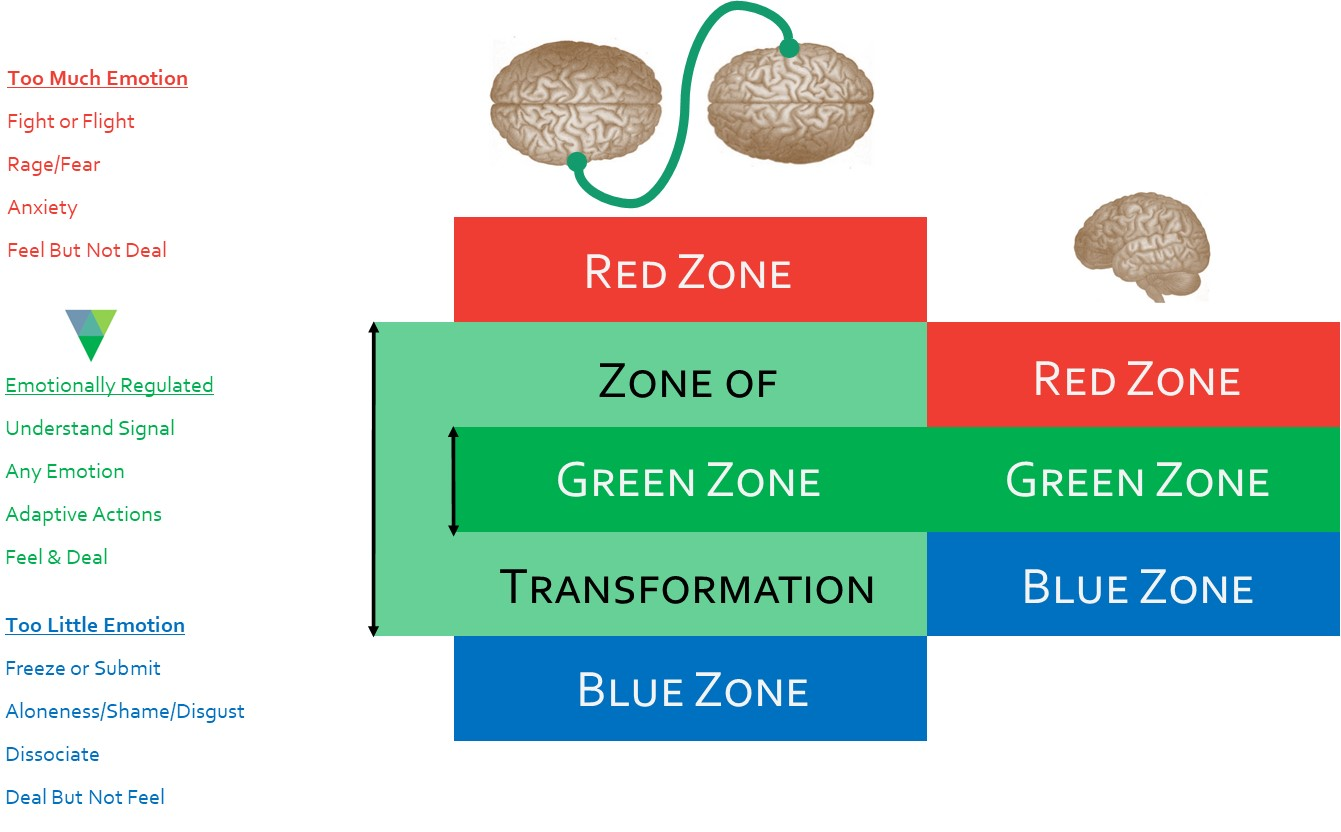
And here is the quiet miracle the model is built on: with a steady, attuned person beside you, brain to brain, your green zone stretches. The book calls that stretched space the zone of transformation. With company, you can feel and deal with what would overwhelm you alone. That is why this work happens in relationship and not from a workbook.
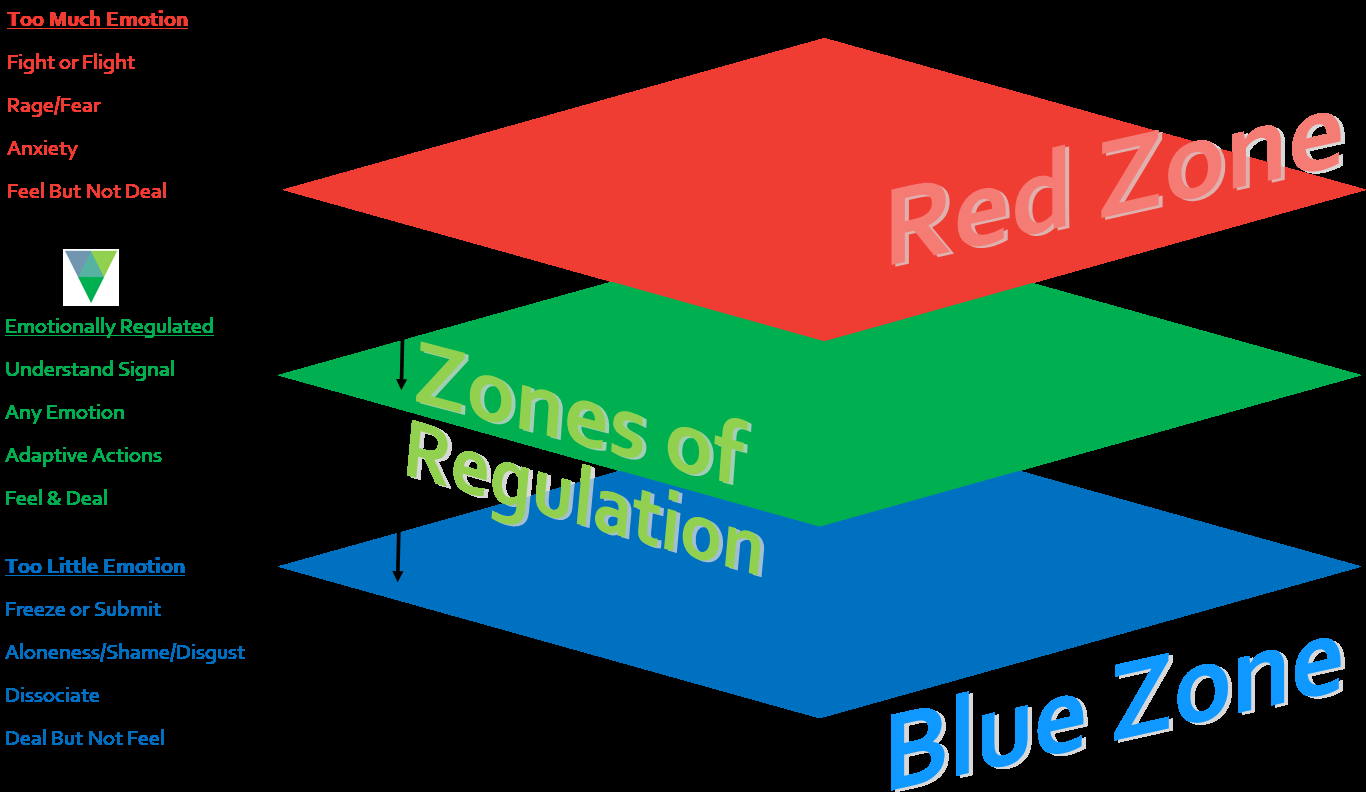
Zones of Regulation: red zone is too much emotion, green zone is feel and deal, blue zone is too little emotion
Zones of Regulation · figure by S. Eggman
Expanded Zones of Regulation: two connected brains stretch the green zone into a zone of transformation
Expanded Zones: two regulated brains stretch the green zone · figure by S. Eggman

The coach's posture

Through all of it, the coach holds the posture Jesus would take with you: unhurried, unshockable, glad to meet every part of you, especially the parts that learned to hide. In this model, grace is not merely discussed. It is experienced, in the room, by the exact parts of you that have never been met with it. That felt experience is the active ingredient.

Why the change lasts

Brain science calls it memory reconsolidation. Plainly: the brain has an edit mode. When an old feeling is fully awake and something happens that contradicts the old lesson, say, you brace for judgment and are met with acceptance instead, the brain rewrites the original learning at its root. The trigger loses its charge. Change made this way tends to hold, because nothing is being suppressed or managed. The root itself was updated.

The three states of the soul

A session moves through three states. The coach's map for the journey is the CFC Avatar.
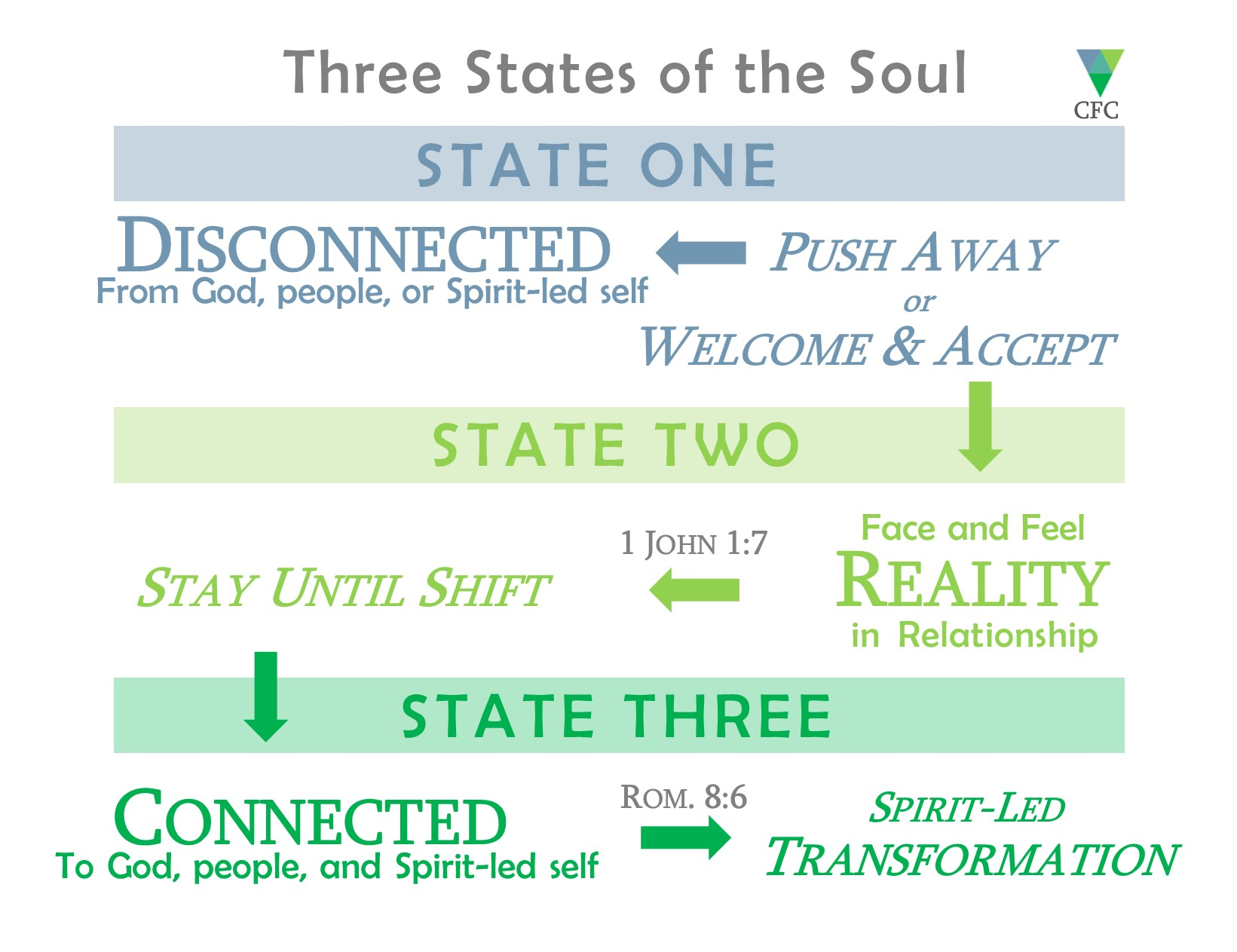
The CFC Avatar: State 1 Disconnected, State 2 Face and Feel in Relationship, State 3 Connection
The CFC Avatar · three states of the soul · figure by S. Eggman
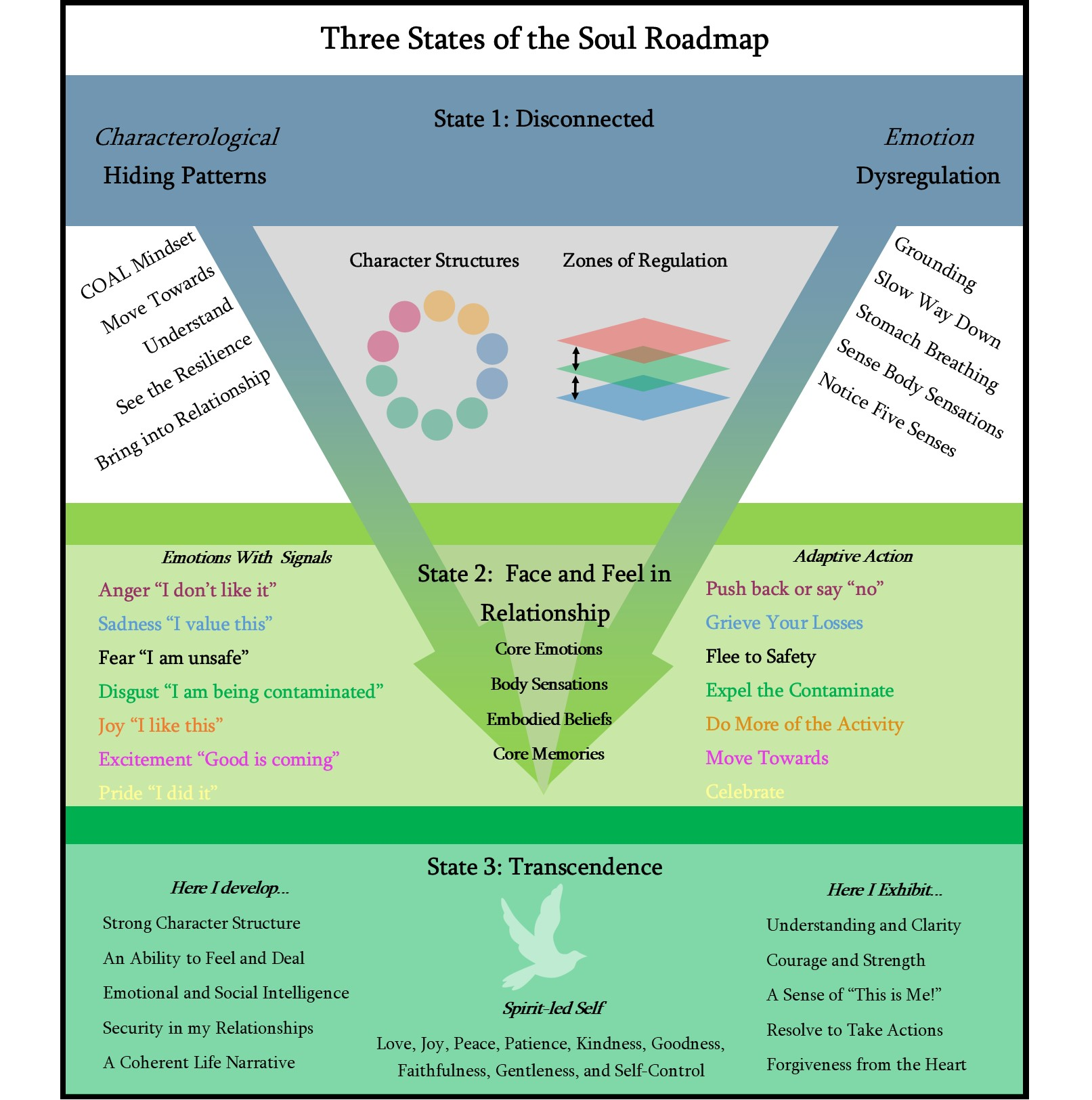
State 1 · Disconnected. Cut off from God, people, or your Spirit-led self, either by hiding patterns (anything we do to avoid feeling) or by emotion that is too much or too little. The way through is not to push the protection away but to welcome and accept everything that shows up.
State 2 · Face and Feel in Relationship. With the coach alongside, you face and feel what is real: the core emotion under the pattern, its body sensations, and the memories it is linked to. Every emotion carries a signal (anger says “I don't like it”; sadness says “I value this”) and points to an adaptive action. You stay with the wave until the shift comes.
State 3 · Connection. The wave settles into connection with God, with people, and with your Spirit-led self, what the book calls transcendence. Understanding and clarity, courage, a sense of “this is me,” resolve to take action, forgiveness from the heart. Here the old learning stays updated and strong character structure gets built.

What changes over time

Old triggers quiet down. The capacities on your map climb their ladders. The hiding patterns retire with honor, because the aloneness they were built for is gone. And the person you are on your best day starts showing up on ordinary ones.

Coaching is growth work, not therapy or medical care. If trauma symptoms such as PTSD are part of your story, a Character Formation Coach will work alongside, or refer you to, a licensed trauma specialist. Both kinds of help matter, and they are friends.

Book a session with a Character Formation Coach

Honesty about what this is

An educational map, stated plainly

The Character Formation Profile is an educational growth map built on published character theory. It is not a diagnosis, a clinical screening, or a validated psychometric instrument, and it never substitutes for licensed care. The Character Formation Inventory is a v1 instrument; items and level ladders are refined as real people use them. Six of the ten capacity ladders were drafted for this profile in the voice of the published charts and are marked as drafts until they appear in the next edition of the book.

Key references

Townsend, J. (1996). Hiding From Love. Zondervan.  ·  Makin, S. & Townsend, J. (2017). Capacities of Character Structure.  ·  Cloud, H. & Townsend, J. (2004). How People Grow. Zondervan.  ·  Cloud, H. (2018). Changes That Heal. Zondervan.  ·  Eggman, A. (2019). Character Formation Coaching. Character Formation Coaching.  ·  Full reference list in the book.