The model

Character is built.

Not assigned, not fixed, not a personality type. Built, the way a house is built: in order, on foundations, by hands other than your own at first, and always finishable. This page is the architecture.

The growing environment

Grace, truth, and time

Townsend calls it the ideal growing environment. Every capacity on this map is built the same way: someone is for you (grace), reality gets told (truth), and the experience repeats enough to become part of you (time). Where all three were present, structure formed. Where one was missing, growth waited.

GraceSomeone for you

Unearned favor and acceptance, delivered through real relationship. The raw material of every structure.

TruthReality, told kindly

Limits, feedback, and honest information about how life works. Structure without truth is sentiment.

TimeEnough repetitions

Growth is seasonal, not instant. Capacities are built by experiences repeated until they become procedural.

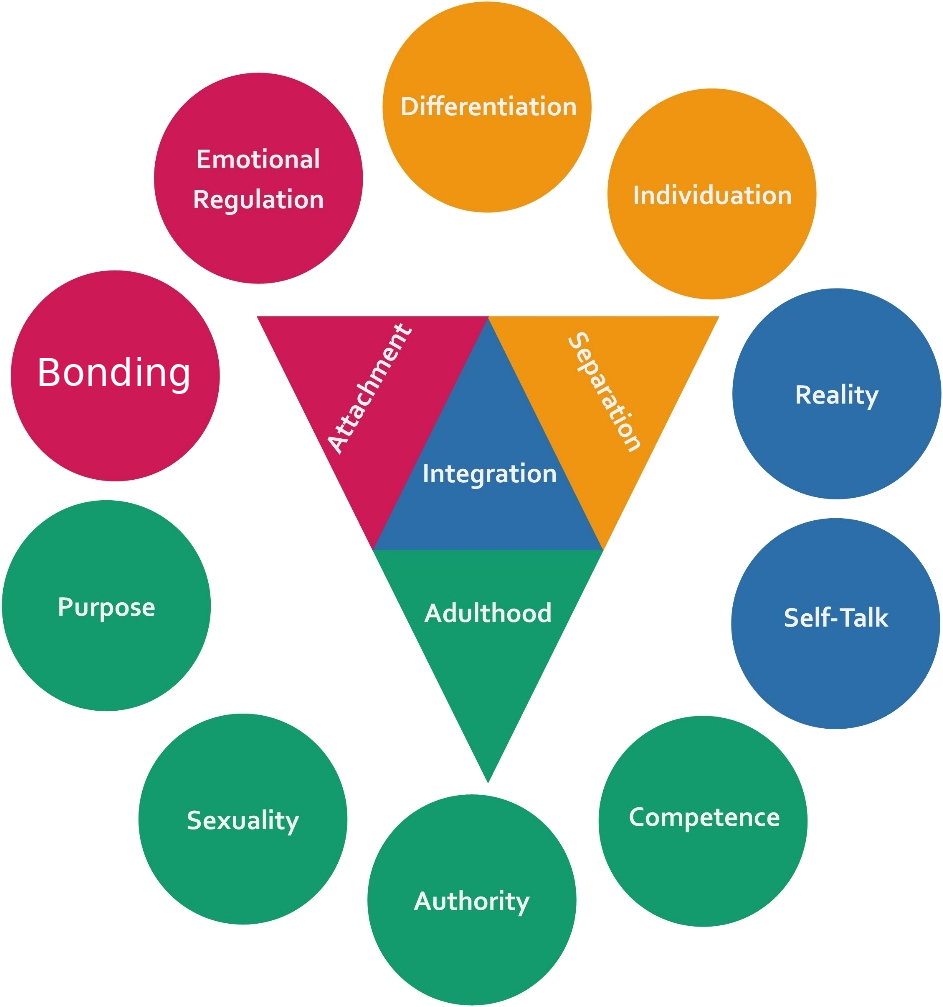
The Character Structures Map: an inverted triangle holding Attachment, Separation, Integration, and Adulthood, surrounded by ten sub-structure circles
Plate 02 · The Character Structures Map · figure by S. Eggman
The map itself

Four structures, ten capacities

The inverted triangle holds the four character structures. Around it orbit the ten sub-structures, the specific, buildable capacities the Profile measures. Each one is defined below and explored in depth on the structure pages.

Attachment · Bonding, Emotional Regulation
Separation · Differentiation, Individuation
Integration · Reality, Self-Talk
Adulthood · Authority, Competence, Sexuality, Purpose

Deep-dive each structure

The construction schedule

When each structure is first built

Development has an order. Each structure gets its founding season early in life, and every one of them can be strengthened at any age afterward, in the right relationships. The season only tells you where the story started, never where it has to end.

Birth to age one

Attachment

In a caregiver's attunement, a baby learns to bond and to co-regulate strong emotion. The felt lesson: my needs bring people, and feelings can be survived together.

Ages two to three

Separation

The first no. A toddler learns she is a distinct self who can differ and still be loved, and begins building an identity of her own.

Ages three to four

Integration

Good and bad turn out to live in the same mother, the same world, the same me. The child learns to hold the whole picture and to speak kindly to himself about it.

Age four onward

Adulthood

Across childhood, adolescence, and adult life: an equal voice among adults, competence in a craft, an integrated sexuality, and a purpose worth being part of.

Half one

Growth levels: how far each capacity is built

Every capacity grows through three observable levels. Level 1 notices and names. Level 2 practices in real relationships. Level 3 becomes a person others can lean on. The Profile places you on each ladder.

See all the level ladders →
Half two

Hiding patterns: where the building paused

Where overwhelming experience met aloneness, a part of you learned to hide, internally (inside your own head) or relationally (in how you handle people). Fifty-three patterns, four structures, all of them honorable veterans that deserve retirement.

Meet the hiding patterns →
Map yourself now